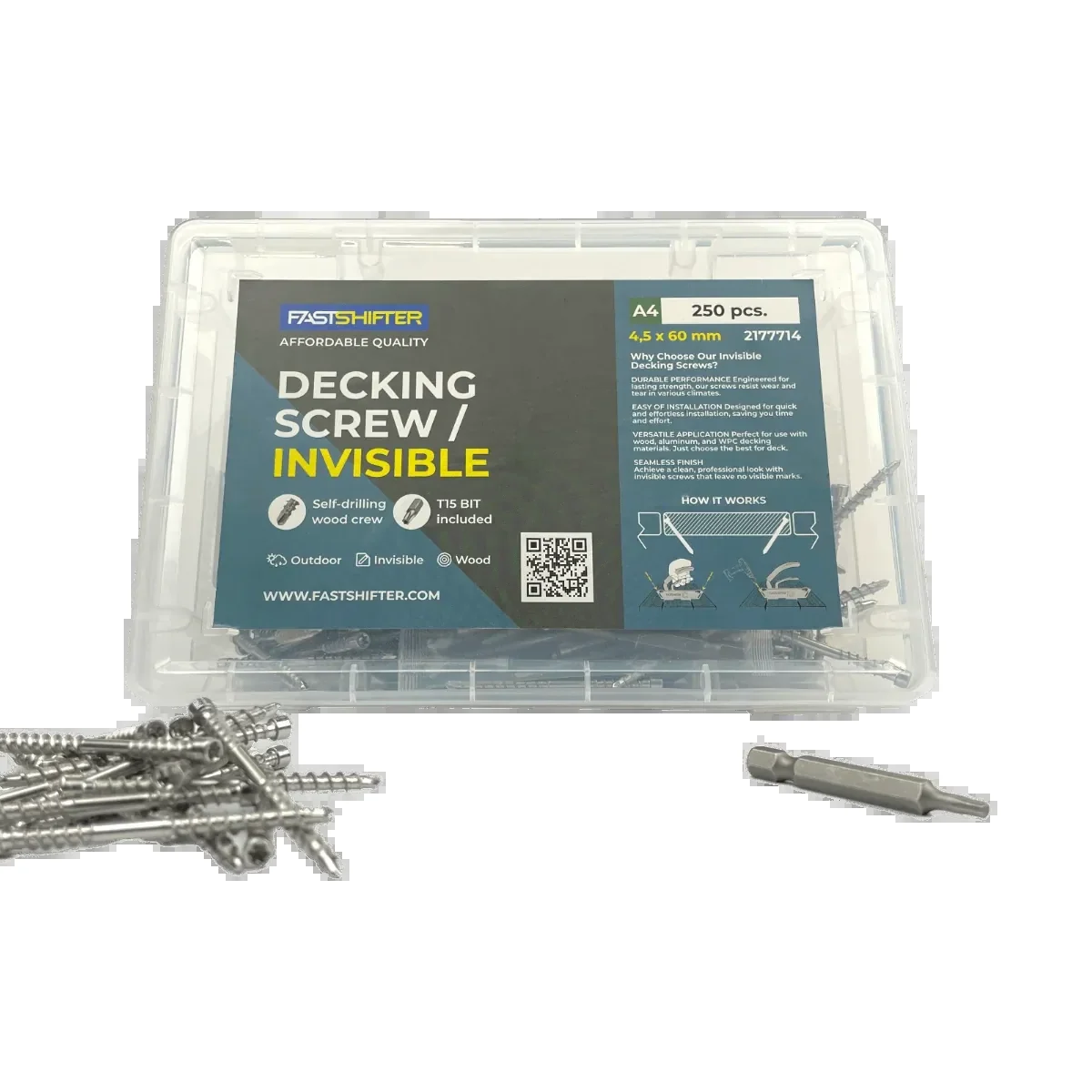
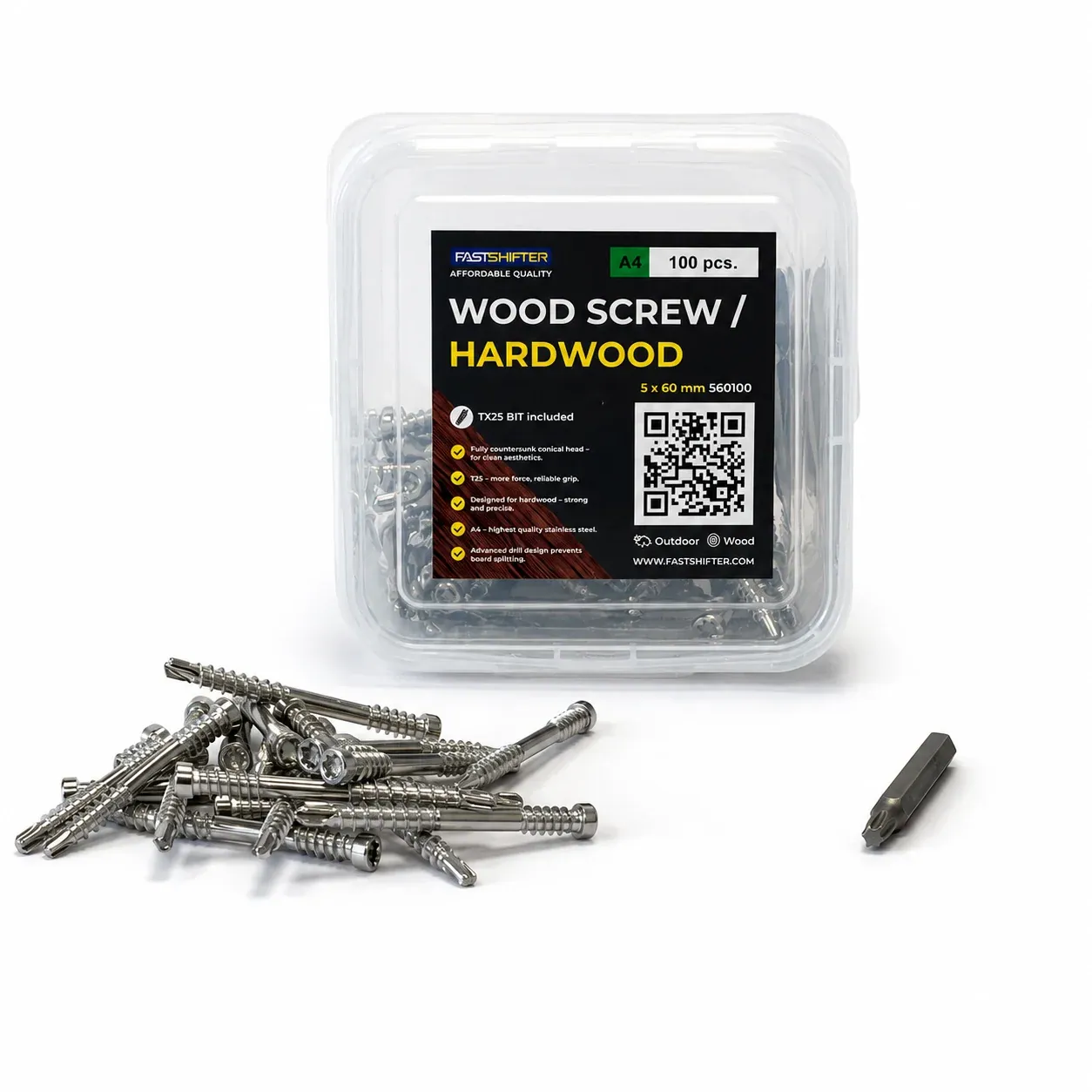
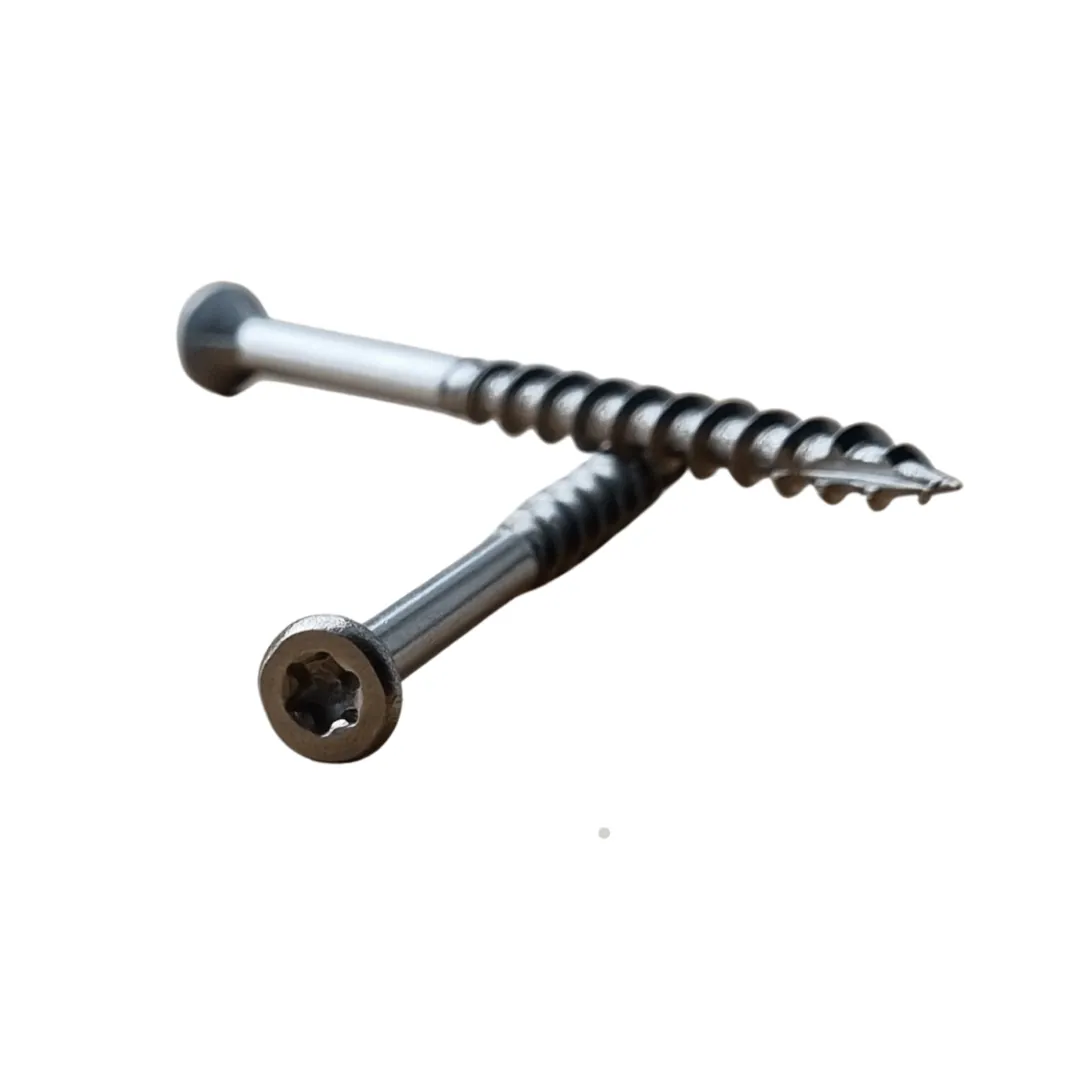
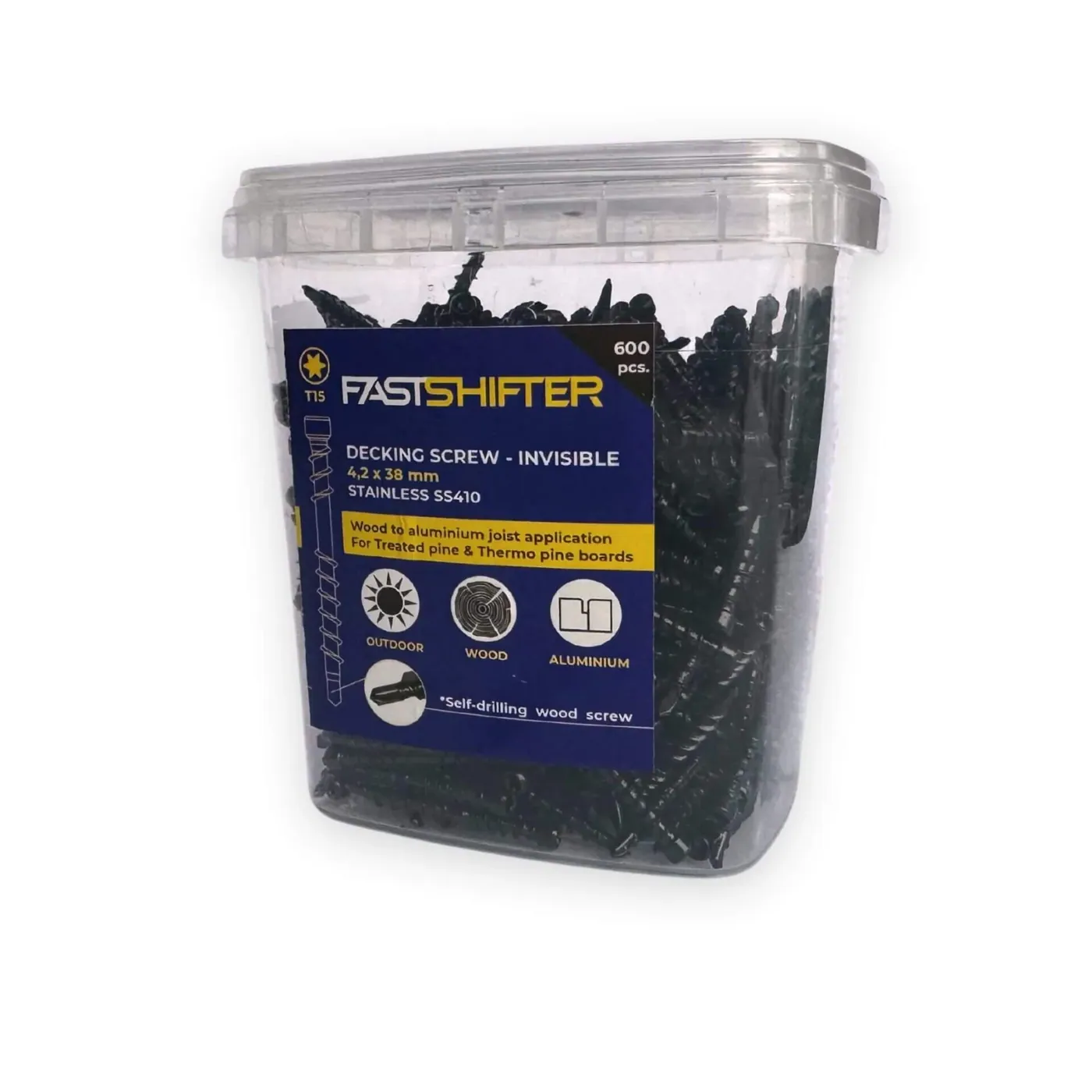
Use A2 stainless for most inland decks and tannin-rich hardwoods such as oak or bangkirai. Use A4 (marine grade) near the sea, by pools and wherever de-icing salt is used. C4 coated carbon steel is a cost-effective option for less aggressive sites. SS410 is a hardened stainless steel, chosen for drilling strength rather than for maximum corrosion resistance.
The steel grade printed on a box of decking screws is the most important number on it, and the one most often ignored. Pick the wrong grade and the screws can stain the boards within weeks, or start to corrode within a few seasons. This guide explains the four grades in our range and when to use each.
The four grades in one table
| Grade | What it is | Corrosion resistance | Strength | Best for |
|---|---|---|---|---|
| A2 | Austenitic stainless steel (≈ 304) | Good outdoors | Standard | Most inland decks, tannin-rich hardwoods |
| A4 | Austenitic stainless with molybdenum (≈ 316) | Very high, resists chlorides | Standard | Coast, pools, de-icing salt, aggressive sites |
| C4 | Carbon steel with a high-performance coating | High (category C4 coating, 1500 h salt spray) | High | Cost-sensitive projects in normal outdoor conditions |
| SS410 | Hardened martensitic stainless steel | Moderate | Highest, self-drilling | Dense timber, aluminium joists, wide-head face screws |
Step 1: Where is the deck?
The environment sets the minimum grade. ISO 9223 classifies atmospheres by corrosivity, from C1 (very low) to C5 and CX (very high and extreme). In deck terms:
| Site | Typical corrosivity | Recommended screw |
|---|---|---|
| Rural or suburban garden, inland | C2–C3 | A2, or C4 coated |
| City, industrial area | C3–C4 | A2 or C4 |
| Near the coast | C4–C5 | A4 |
| Around a swimming pool (chlorine or salt water) | Aggressive locally | A4 |
| Roads or paths treated with de-icing salt nearby | Aggressive locally | A4 |
Even A4 can show light tea staining by the sea if it is never cleaned. If in doubt, go one grade up. The price difference per deck is small compared with the cost of replacing stained boards.
Step 2: What timber is it?
The timber can be as aggressive as the climate.
- Tannin-rich hardwoods such as oak, bangkirai, garapa, cumaru and ipe react with iron and leave dark stains. Use stainless: A2 is generally sufficient inland, A4 on the coast. Dense species also need a screw made for hardwood and usually pre-drilling. Our A4 hardwood screw is made for exactly that.
- Thermally modified timber is more acidic than untreated softwood and is brittle at the edges. Stainless screws and pre-drilling near board ends are the safe approach.
- Pressure-treated softwood contains copper compounds that are corrosive to plain steel. Stainless or a properly rated coating is essential.
- Composite (WPC): follow the board manufacturer’s fixing system.
Step 3: What is the frame made of?
On aluminium joists, the screw must drill through metal. That is where a hardened, self-drilling screw such as our SS410 screw for aluminium joists is the right tool. On timber joists, use A2, A4 or C4 according to steps 1 and 2.
A2 vs A4: the difference that matters
Both are austenitic stainless steels. A4 contains around 2 % molybdenum, which greatly improves resistance to chlorides: salt spray, pool water and road salt. Chlorides are what cause pitting and the brown “tea staining” seen on A2 by the sea. Inland, A2 performs very well. On the coast, A4 is the professional standard.
Where C4 coated screws fit
A modern C4 coating gives carbon steel a long outdoor life at a lower price than stainless. It is a good choice for softwood and thermowood decks in normal outdoor conditions, especially on large projects where cost matters. Be careful in two cases: tannin-rich hardwoods, where a coating damaged during driving can lead to staining, and coastal sites, where A4 is the safer choice.
Where SS410 fits
SS410 can be hardened, which makes the screw stronger and lets it drill its own hole. That is ideal for wide-head face screws and for screwing into aluminium. The trade-off is lower corrosion resistance than A2 or A4: heads may show light surface rust over time. Keep SS410 away from salt and pools, and in oak and tropical hardwoods choose A2, which is safer against staining.
Quick decision guide
- Inland, softwood or thermowood → A2 or C4
- Inland, oak or tropical hardwood → A2 stainless, pre-drill
- Coast or pool, any timber → A4
- Aluminium joists → SS410 self-drilling joist screw (on the coast, use the fixing specified by the frame maker)
- Wide-head screws for edge boards and steps → SS410 or A2, colour-matched heads; A2 in tannin-rich hardwood
Fastshifter screw range by grade
- Invisible edge screws 4.5 × 60 mm in A2, A4 and C4
- Face screws in A2 4.8 × 65 mm (also with coloured heads) and SS410 wide head
- Structural screws: FT Twister A2 for the frame
Read next: hidden screws vs face screws vs clips.
Frequently asked questions
What is the difference between A2 and A4 stainless steel?
A2 (comparable to grade 304) is a general-purpose stainless steel with good outdoor corrosion resistance. A4 (comparable to grade 316) adds molybdenum, which makes it much more resistant to chlorides from sea air, pool water and road salt.
Do I need A4 screws near the sea?
Yes. On coastal sites salt spray will attack A2 over time and can cause staining and pitting. A4 is the standard recommendation for coastal decks and for decks around swimming pools.
Why do some screws leave black stains on hardwood?
Tannin-rich timbers such as oak, bangkirai, garapa and many tropical species react with iron. Carbon-steel screws, and coated screws whose coating is damaged when driven, can cause blue-black stains around the head. Stainless screws avoid this.
What does C4 mean on a screw?
ISO 9223 classifies environments by corrosivity, and C4 means high. A C4 screw coating is designed for use in that kind of environment. Our C4 invisible screws are tested to 1500 hours of neutral salt spray. Salt-spray hours compare coatings; they do not translate directly into years of service.
Is SS410 stainless steel good for decks?
SS410 is a hardened stainless steel. It is stronger and can drill its own hole in dense timber or thin metal, but it is less corrosion resistant than A2 or A4. Use it where strength and self-drilling matter and the site is not coastal.
What screw length do I need for decking?
A common rule of thumb is a screw about 2.5 to 3 times the board thickness. For 21 mm boards, a 60 mm screw is typical; for thicker boards, go longer.