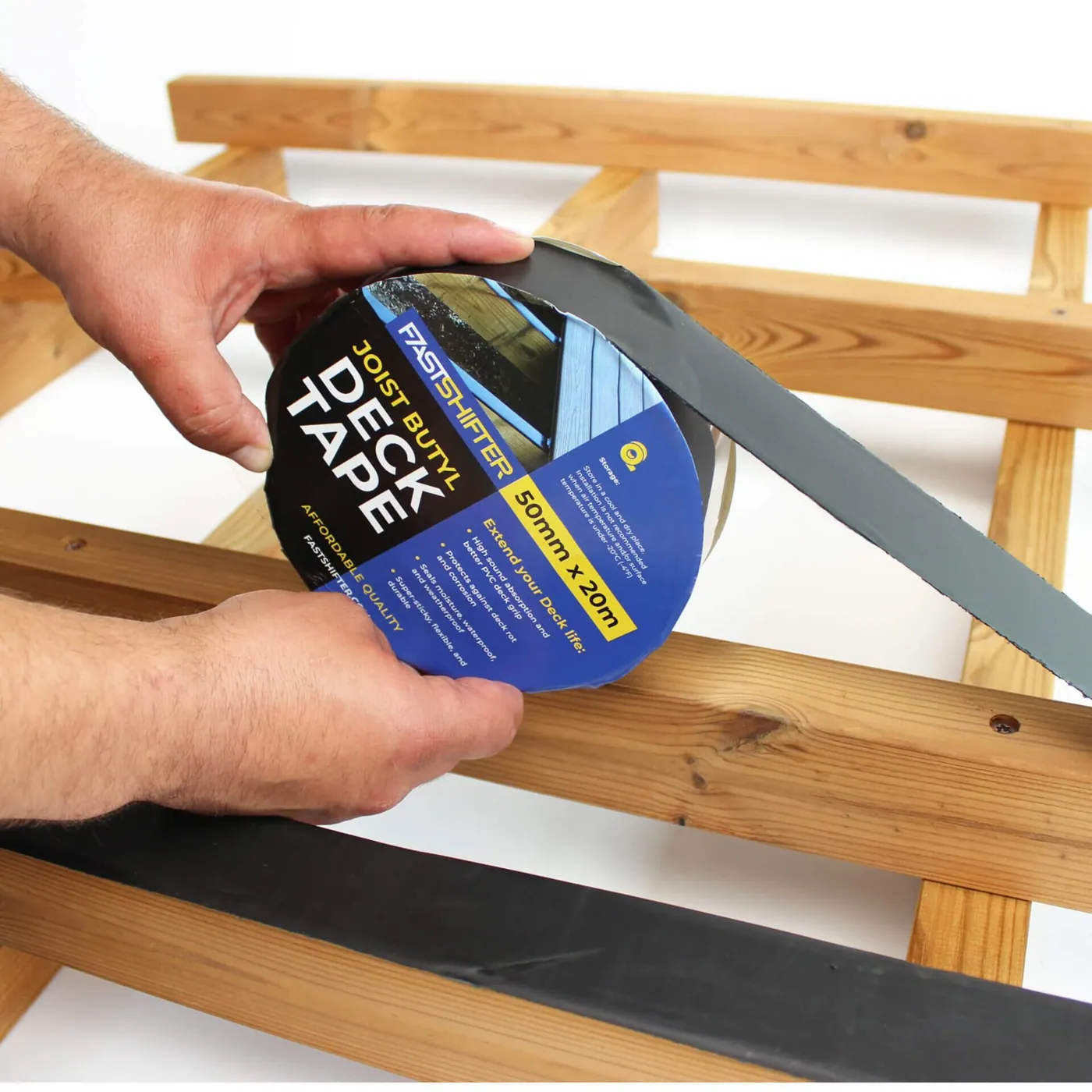
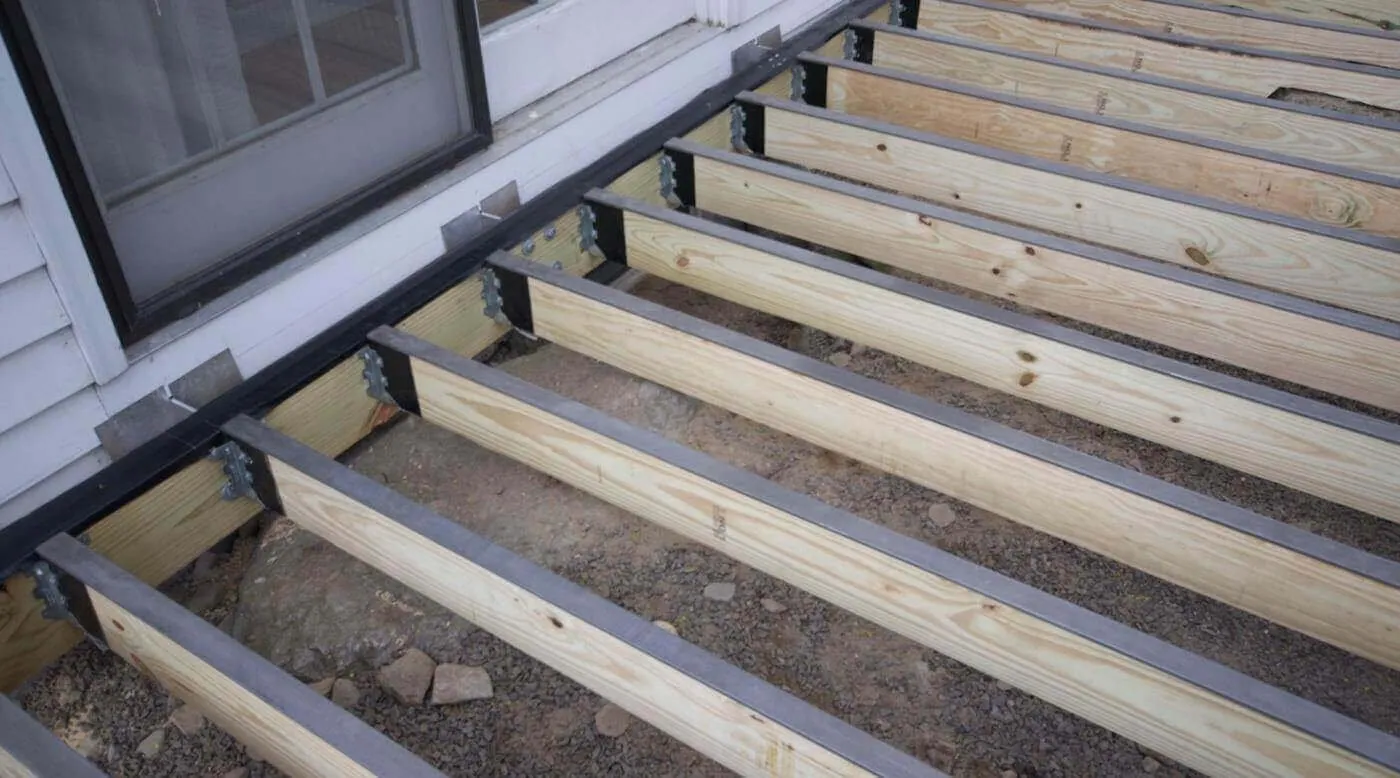
Joist tape is a self-adhesive strip applied to the top of every joist before the boards go down. It sheds the water that would otherwise sit on the joist, and a butyl tape seals around every screw as it is driven. It protects the part of the deck that rots first, and it costs only a small fraction of the boards.
Builders rarely get asked about joist tape, because clients never see it. Once the boards are down, it disappears. Yet it can add many years to the life of a timber frame.
Why joists rot from the top
Look at a failed deck frame and the pattern is usually the same. The sides of the joist are fine. The decay is along the top face and around every screw. There are two reasons:
- Water sits on top of the joist. Rain runs through the board gaps and lands on the narrow top face of the joist. Under the board it dries slowly, so that strip of timber stays damp far longer than the rest of the frame.
- Every screw opens a path into the timber. Each fixing breaks the surface and its treatment. Water follows the screw shank into the core of the joist, where it is hardest to dry out.
Pressure treatment helps, but it does not change either of these mechanisms. Since CCA treatment was restricted in the EU, copper-based treatments are used instead. Treatment often does not penetrate to the core, so cut faces and screw holes still need protection, and copper treatments are more corrosive to fasteners.
What joist tape does
| Function | How it works |
|---|---|
| Sheds water | The tape covers the top face, so water runs off instead of soaking in |
| Seals screw holes | Elastic butyl closes around the screw shank as it is driven |
| Protects metal frames | Separates aluminium or steel joists from boards and fixings |
| Reduces noise | A soft layer between board and joist damps footfall and creaks |
| Reduces board slip | Textured tapes may help reduce micro-movement between board and joist |
Butyl, bitumen or rubber?
Butyl is the material most professionals prefer. It stays tacky and elastic in summer heat and winter cold, it bonds to timber, metal and composite, and above all it self-seals around a screw.
Bitumen (asphalt) tapes are cheaper and also seal when new, but they can soften, bleed and creep in heat and harden with age. A cracked tape funnels water into the joist instead of keeping it out.
Rubber strips do a different job. A thicker granulate rubber tape such as our adhesive rubber tape is used as a bearing strip, as a damping layer, or to form a consistent drainage gap. It is not a replacement for a sealing joist tape on timber.
Which Fastshifter tape for which job
| Situation | Tape |
|---|---|
| Standard timber joists | Butyl joist tape 50 mm |
| Board end joints, wider joists and beams | Butyl joist tape 80 mm |
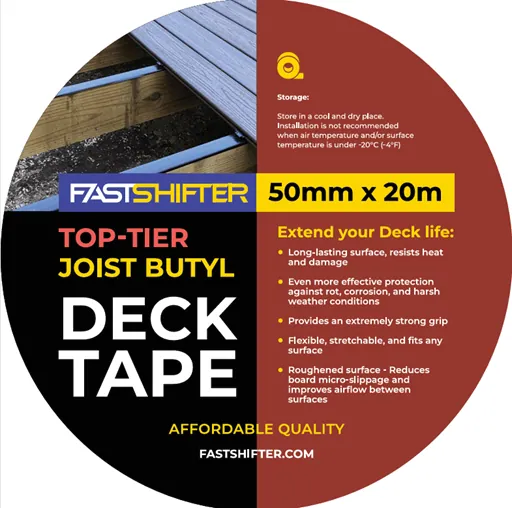
| Heavy-use and commercial decks, creak reduction | Top-Tier reinforced tape with textured surface |
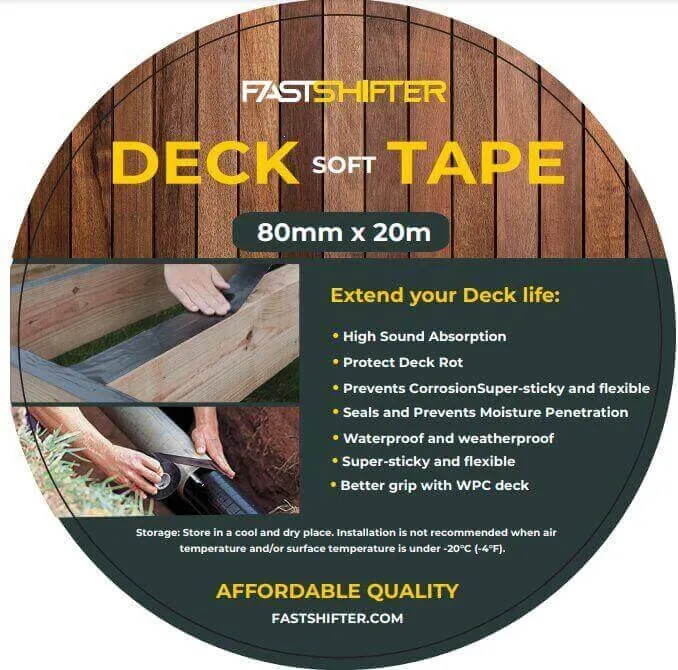
| Decks over rooms or balconies where noise matters | Deck Soft Tape with a cushioning core |
| Drainage gap at side boards, bearing strip | Adhesive rubber tape 3 or 5 mm |
How to apply joist tape properly
- Finish the frame first. All joists level and fixed, noggins in place.
- Clean and dry the top face. Brush off sawdust. Tape does not stick to wet or dusty timber.
- Choose the width. It should overlap the joist slightly on both sides. Where two boards butt together over one joist, use the wide tape. On double joists, run two strips or cover both joists completely.
- Roll it out and press it down along the full length, working out air bubbles. A small roller helps on long runs.
- Fold over the ends of joists and bearers where the end grain is exposed.
- Do not stretch it around corners. Cut and overlap instead.
- Fix the boards straight through the tape. That is where the self-sealing does its work.
Common mistakes
- Tape narrower than the joist. Water runs down the exposed edge and into the timber.
- Only taping the joists, not the bearers. Every horizontal timber that holds water needs protection.
- Taping wet timber. The tape lifts within a season.
- Using tape as an excuse for poor ventilation. Tape protects the top face; the rest of the frame still needs to dry.
The economics in one sentence
For a typical deck, the tape costs a small fraction of the boards, and it protects the timber that is most expensive to replace. That makes it one of the easiest upgrades to sell, and one of the easiest to justify to a client.
Read next: why the substructure matters more than the boards.
Frequently asked questions
Is joist tape really necessary?
It is not structurally required, but it is the cheapest way to extend the life of a timber frame. Joists usually decay from the top face and from the screw holes, exactly where the tape protects them. Many professional builders now treat it as standard.
Butyl or bitumen joist tape: which is better?
Butyl. It stays elastic across hot and cold seasons and seals tightly around screw shanks. Bitumen (asphalt) tapes can soften in heat and harden or crack over time, so their seal weakens.
What width of joist tape do I need?
Use tape a little wider than the top of the joist: 50 mm for a single standard joist, 80 mm for wider joists and wherever two board ends meet over one joist. On double joists, use two strips or a tape wide enough to cover both.
Should joist tape go on treated timber too?
Yes. Pressure treatment slows decay but does not stop water sitting on the joist and entering through screw holes. Tape protects treated, untreated and thermally modified timber alike.
Do aluminium joists need tape?
Tape on aluminium is less about rot and more about separating the metal from the board and fixings, damping noise and reducing board slip. A soft or textured tape works well there.
Can I apply joist tape in cold or wet weather?
Apply it to a clean, dry joist. Moisture, sawdust and very low temperatures all weaken adhesion. If the timber is wet, let it dry first or wait for better conditions.