Invisible edge screws give a clean surface on standard, ungrooved boards and are fast with a guide tool. Face screws are the simplest and hold wide or cupped boards down hardest, but the heads stay visible. Clips hide the fixing too, but they need grooved boards. Choose by board type first, then by the look the client wants.
There is no single best way to fix a deck board. There are three good ones, and each fits a different board and a different client. This comparison is written for builders choosing a method for a job, and for dealers deciding what to stock.
The three methods at a glance
| Invisible edge screws | Face screws | Hidden clips | |
|---|---|---|---|
| Surface | Clean, no heads | Heads visible (colour-matched heads available) | Clean, no heads |
| Board type | Standard ungrooved boards | Any board | Grooved boards only |
| Hold-down force | Good (double thread) | Highest | Depends on clip system |
| Speed | Fast with a guide tool | Fastest per fixing | Medium |
| Board gap | Set by the tool or spacers | Set by spacers | Set by the clip |
| Water at the fixing | No heads for water to sit in | Water sits around each head | Usually none on top |
| Board replacement | Possible from the edge | Easiest | Can be awkward |
| Typical use | Premium timber and thermowood decks | Budget decks, wide boards, stairs, edges | Composite and grooved hardwood |
Invisible edge screws
An invisible decking screw is driven at an angle through the side edge of the board into the joist. The head sits inside the board edge, where nobody will see it. A double thread pulls the board down onto the joist and closes the joint.
Why builders like them
- The surface reads as one clean plane, which clients pay more for.
- There are no heads for water and dirt to collect around, and no heads to splinter the timber.
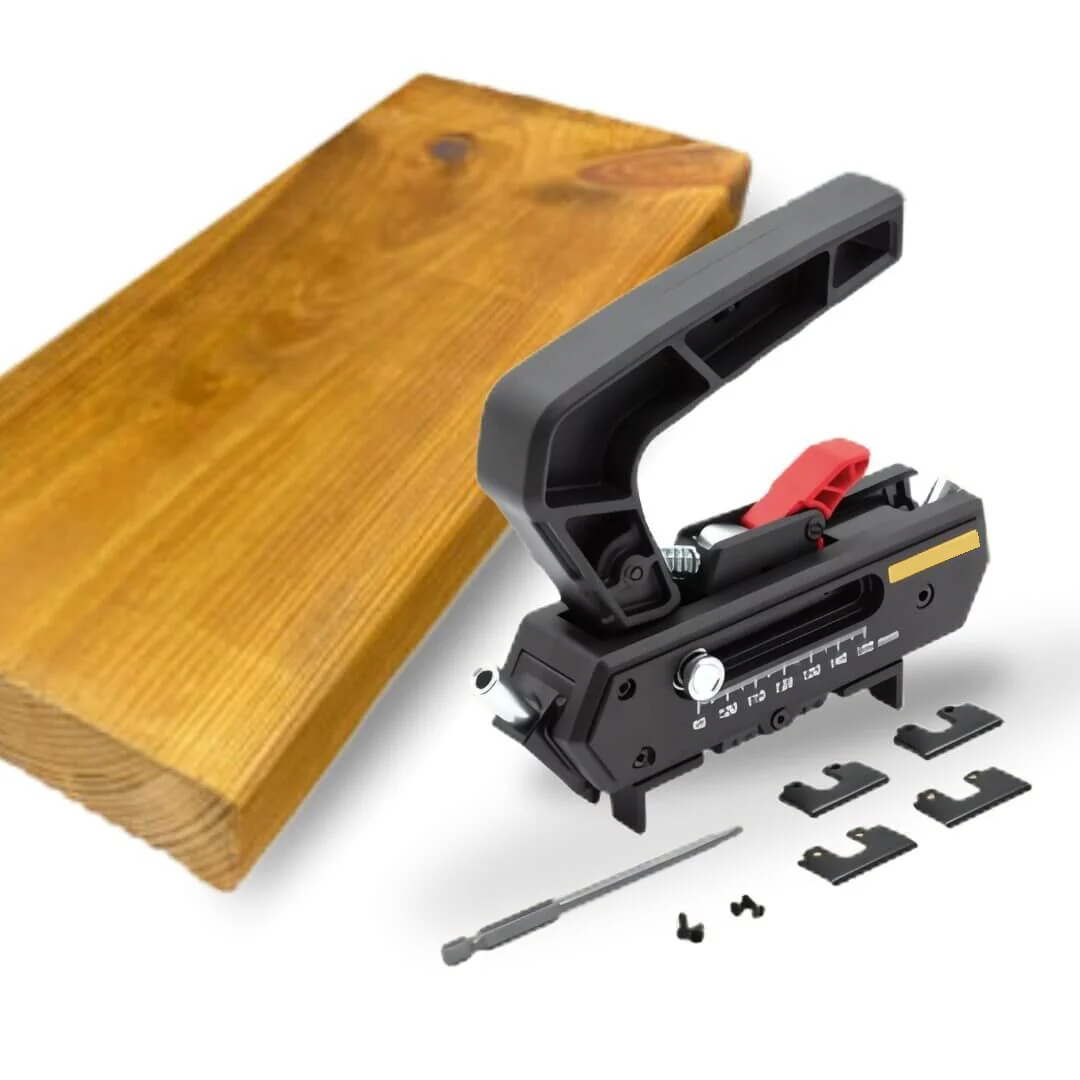
- With a guide tool, every screw goes in at the same angle, depth and spacing, and board gaps stay consistent.
- They work on ordinary ungrooved boards, so the client is not tied to a specific grooved product.
Watch out for
- Dense hardwoods: pre-drill, and use a screw made for hardwood.
- Board width: the guide tool covers 90–150 mm. Wider boards are better face-fixed or fixed with a system designed for them.
- Material choice: hidden or not, the screw still lives outdoors. Choose A2, A4 or C4 to suit the site.
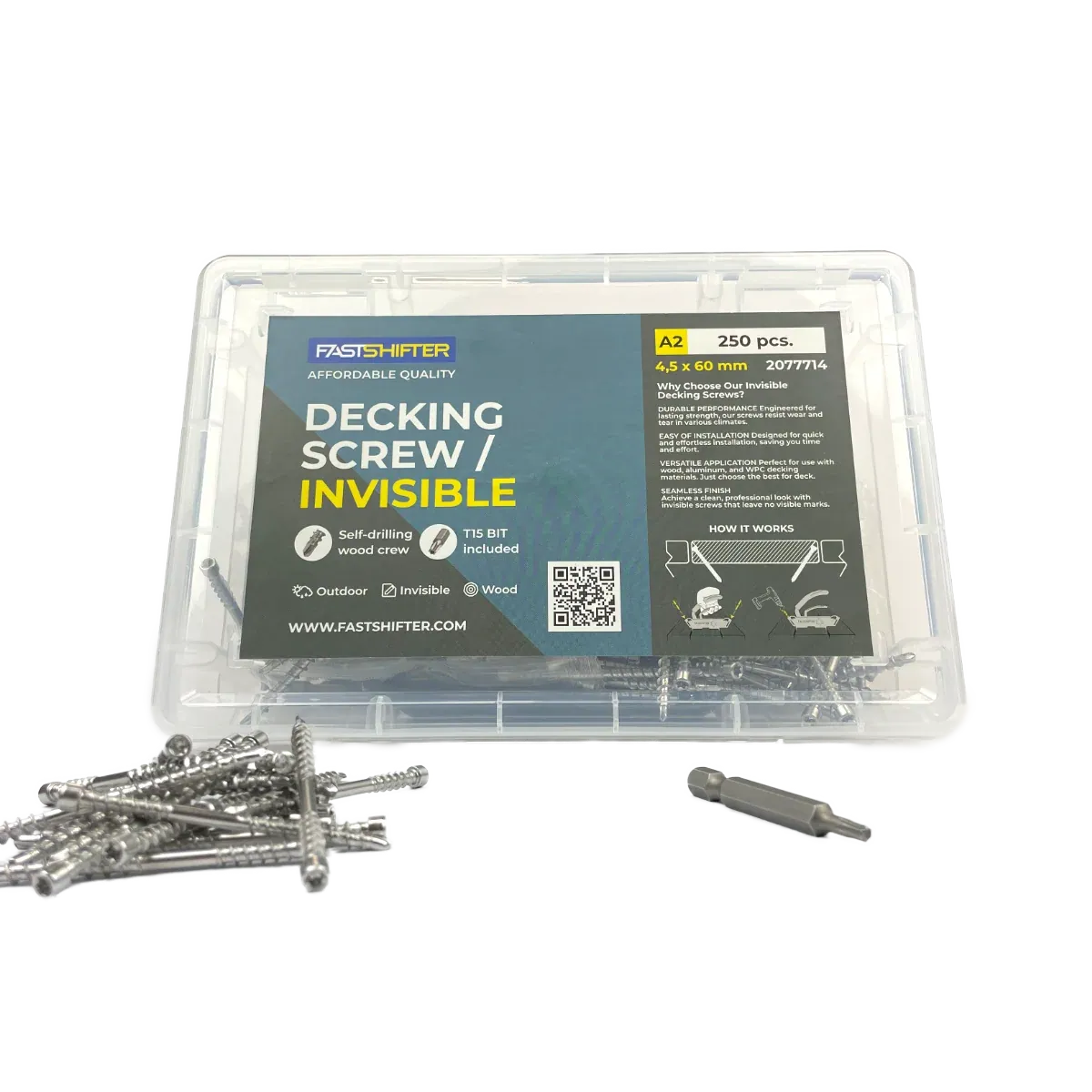
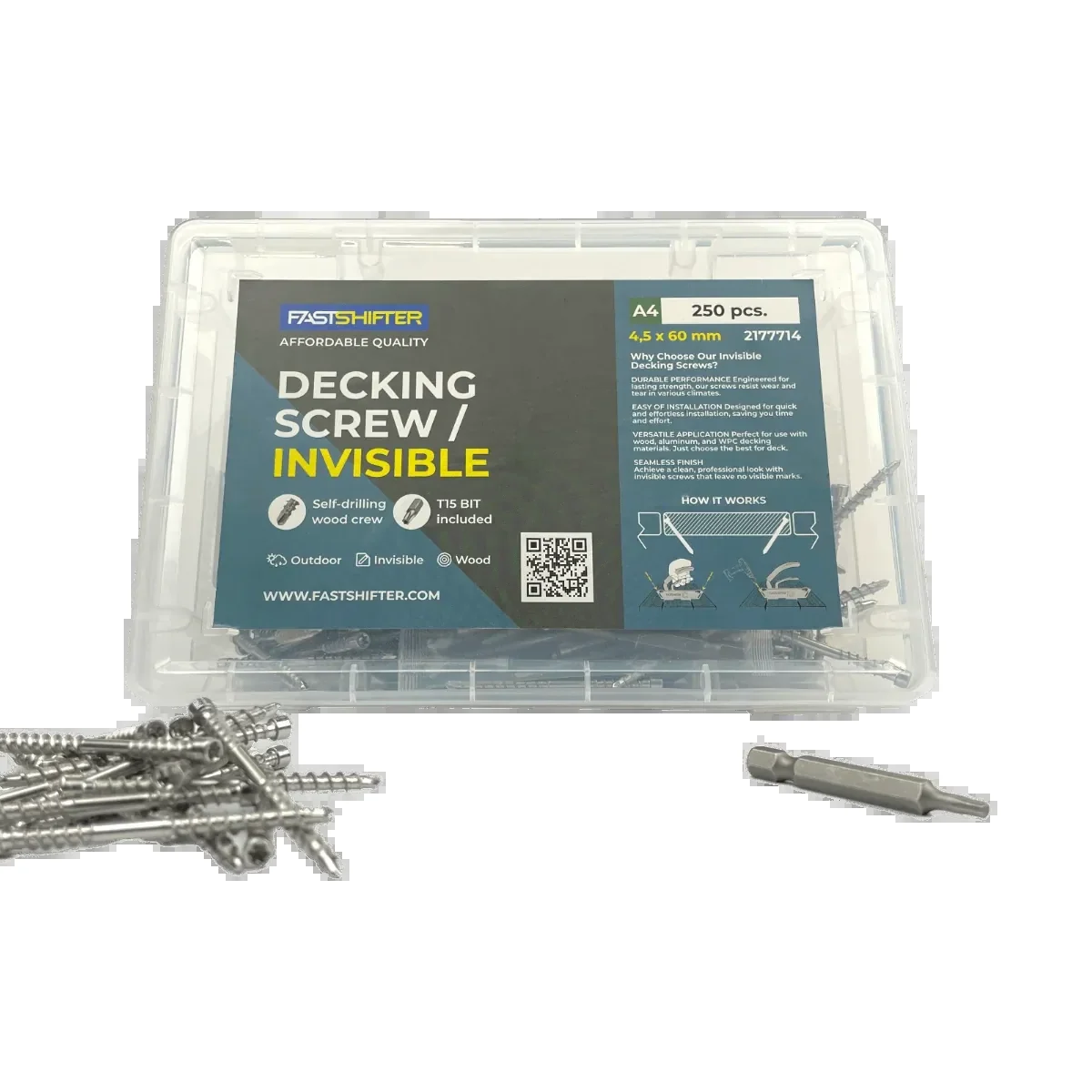
Fastshifter invisible screws come in A2 stainless, A4 marine-grade stainless and C4 coated carbon steel (1500 h salt spray), all 4.5 × 60 mm with a T15 drive.
Face screws
Face screwing is the traditional method: two screws through the top of the board into every joist.
Why it still has a place
- It is the simplest method, needs no special tool, and works on any board.
- It gives the highest hold-down force, which matters for wide boards that tend to cup and for end boards, fascia and steps.
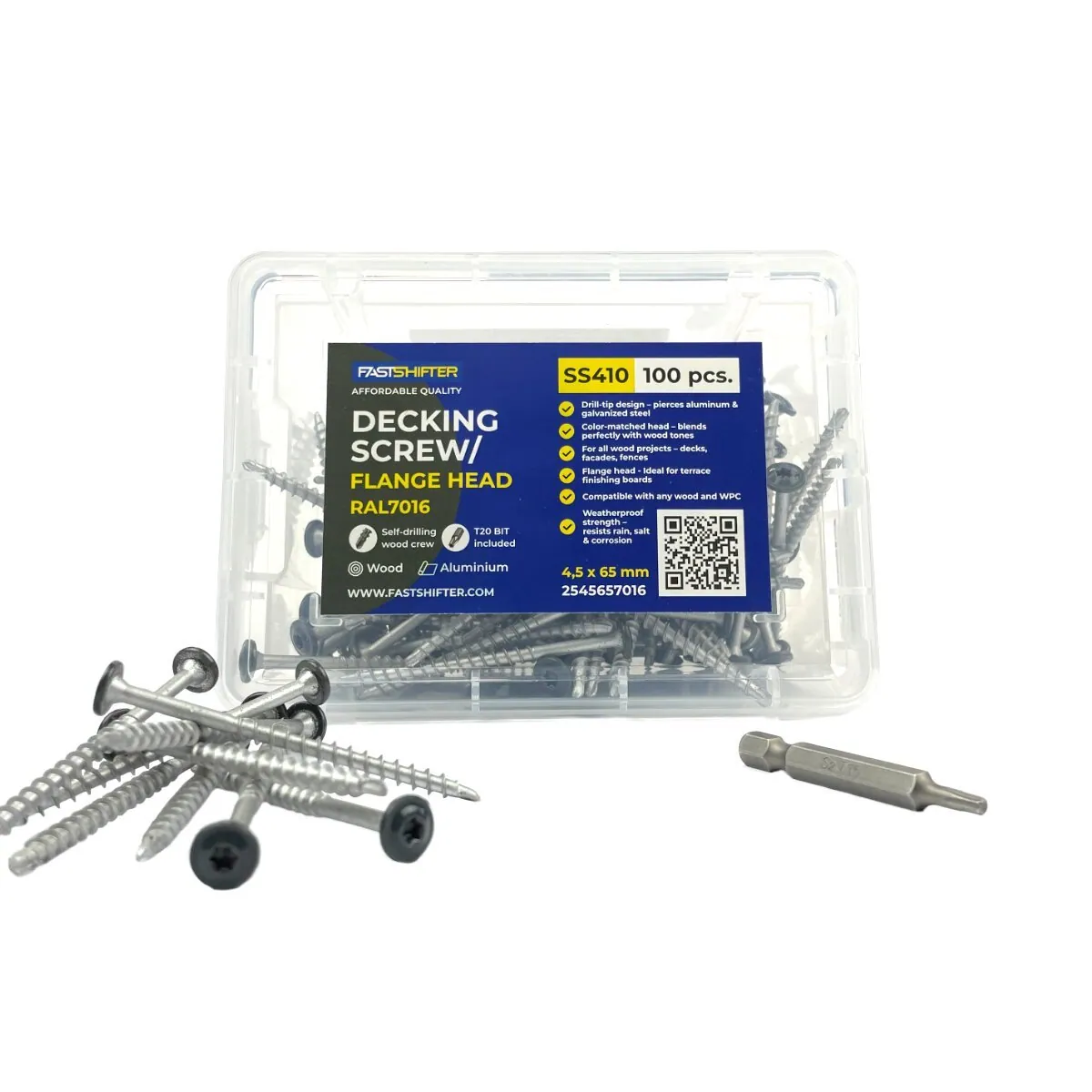
- A wide-head screw spreads the clamping load and pulls a board flat. Painted heads (for example Terra Brown or Anthracite Grey) turn a line of screws into a deliberate detail.
Watch out for
- Keep screws a consistent distance from the board edge. Our deck board spacer has a notch for exactly that.
- Pre-drill hardwood and the ends of boards to avoid splitting.
- Drive heads flush, not deep. An over-driven head makes a cup that holds water.
Hidden clips
Clips sit in a groove milled into the board edge and are screwed to the joist. They set the gap automatically and hide the fixing.
They are the standard method for most grooved composite boards, and many board manufacturers require their own clip to keep the warranty. On grooved hardwood they also work well. The limitation is simple: no groove, no clip.
How to choose in three questions
- Is the board grooved? If yes, follow the board maker’s clip system. If no, go to question 2.
- Does the client want a screw-free surface? If yes, use invisible edge screws with a guide tool. If no, go to question 3.
- Is the board wide, cupped or on an edge or step? Use wide-head face screws there, even on a deck that is otherwise hidden-fixed.
Many good decks combine methods: hidden screws in the field, wide-head face screws on the edge boards and steps.
What to stock as a dealer
- Invisible screws in A2 for most inland projects, A4 for coastal and pool projects, and C4 as the price-sensitive option.
- The guide tool, because it sells the screws.
- Wide-head face screws in two or three head colours.
- Spacers and a board compression tool for straightening bowed boards.
Read next: A2, A4, C4 or SS410: choosing decking screws by climate and timber.
Frequently asked questions
What are invisible deck screws?
They are screws driven at an angle through the side edge of the board into the joist, so no head shows on the surface. A double thread pulls the board down tight. A guide tool sets the angle, depth and spacing for every fixing.
Do hidden deck screws work with any board?
They work with most standard, ungrooved timber and thermally modified boards of usual widths. Our guide tool covers boards from 90 to 150 mm. Very dense hardwoods may need pre-drilling. Grooved composite boards are normally fixed with the clips their manufacturer specifies.
Are hidden screws slower than face screws?
By hand they can be. With a guide tool and a good impact driver the difference is small, and you save time on finishing because there are no heads to align or plug.
Can a board fixed with hidden screws be replaced?
Yes. The screws can be backed out from the edge, although it is a little more work than with face screws. That is still usually easier than lifting boards fixed with a continuous clip system.
When are face screws the better choice?
On wide or cupped boards that need pulling flat, on end boards and fascia, on stairs, and wherever maximum hold-down matters more than appearance. Colour-matched heads keep them neat.
How many screws per board per joist?
For face fixing, two screws per board at every joist is standard. For edge fixing, follow the system instructions; boards are usually fixed on both edges at each joist.